If you’ve ever tried to find a price on BuzzBoard’s website, clicking through Ignite, Zylo, and Ember product pages looking for a dollar figure, only to land on a “Talk to Us” button with no numbers in sight, you know the frustration. There are no prices. The only path to a number is a sales call.
BuzzBoard is an AI platform for marketing service providers that sell to small and medium businesses. It draws on a database of 30 million SMB profiles and organizes its product around three modules: Ignite for sales prospecting, Zylo for marketing fulfillment, and Ember for customer retention. Each module solves a different problem and uses a different pricing metric. But BuzzBoard publishes no prices. Every configuration is custom-quoted, and the only way to get a number is through a sales conversation.
We’ve analyzed BuzzBoard’s pricing structure, product modules, and commercial model. BuzzBoard’s pricing works if:
- You’re an enterprise buyer accustomed to negotiating custom contracts and have procurement resources to manage that process
- Your organization manages hundreds or thousands of SMB accounts, where per-seat, per-asset, or per-account pricing fits your operating model
- You want to start with one module (sales, fulfillment, or retention) and expand later without switching platforms
- Your budget allows for enterprise software investment, and you value a shared data layer over assembling separate tools
- You need SOC 2 Type II compliance and enterprise security as baseline requirements, not premium add-ons
BuzzBoard’s pricing is a poor fit if:
- You need transparent pricing to build a business case before engaging with a sales team
- Your agency manages fewer than 50 SMB clients, where enterprise pricing may not justify the investment
- You prefer self-serve purchasing with predictable monthly costs you can budget without a sales call
- You’re comparing multiple tools and need side-by-side pricing to evaluate options
- You want to test the platform before committing, since no free trial or self-serve entry point exists
Want to start the conversation? You can request a quote from BuzzBoard here. Otherwise, read on for the full breakdown.
Here’s what we know about BuzzBoard’s pricing.
BuzzBoard Pricing Summary
| BuzzBoard | |
|---|---|
| Free Trial | None available. No self-serve trial or free plan. Entry point is a sales demo. |
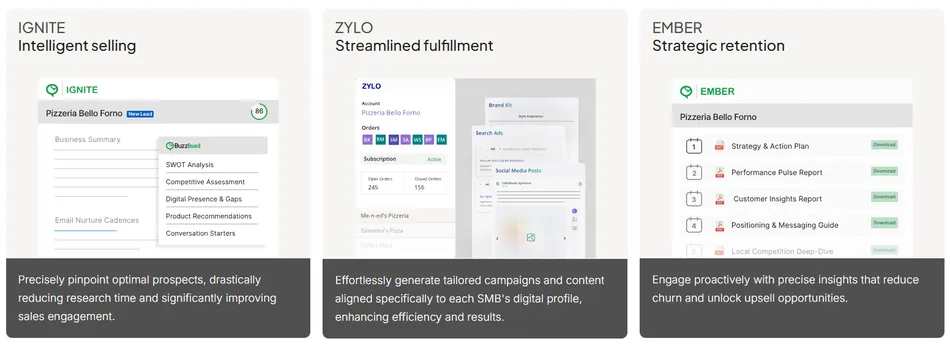
| Ignite (Sell) | Custom-quoted per seat. For sales and revenue teams. Includes lead intelligence, AI-generated cadences, Chrome Extension. |
| Zylo (Deliver) | Custom-quoted per marketing assets and customers. For fulfillment teams. Includes AI content generation, brand guardrails, one-click publishing. |
| Ember (Retain) | Custom-quoted per accounts under management. For customer success teams. Includes onboarding briefs, progress reports, upsell detection. |
| Best For | Enterprise marketing service providers managing hundreds to thousands of SMB client accounts |
BuzzBoard Pricing: In-Depth Overview
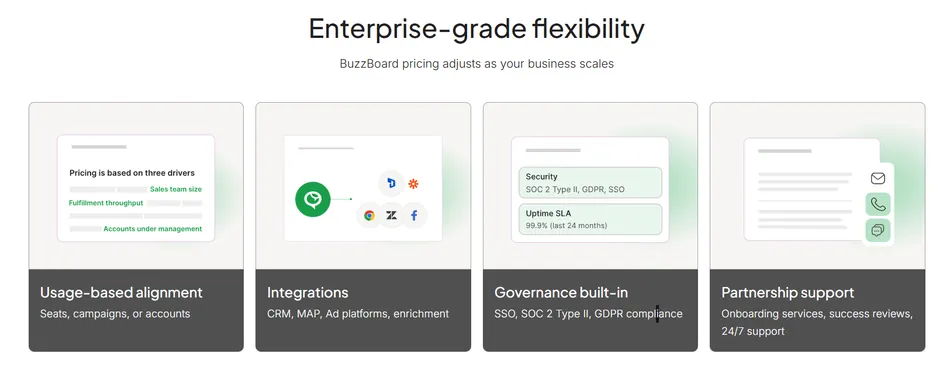
BuzzBoard operates on a custom-quoted enterprise model with no published prices. The platform sells three products, each using a different pricing metric tied to how your team uses it. BuzzBoard calls this “one platform, three entry points”, so buyers can start with one module and expand later. Every configuration includes security, APIs, and baseline support. Integrations, additional AI agents, and enhanced support are negotiated as add-ons. Here’s what each module includes and how costs likely scale.
Ignite: Sales Intelligence and Outreach (Priced Per Seat)
| Feature | Details |
|---|---|
| Pricing Metric | Per seat (custom-quoted) |
| Target Team | Sales and revenue teams |
| Core Agents | Leads Agent, Sales Agent |
| Data Access | 30M+ SMB profiles, 6,000+ signals |
| CRM Integrations | Salesforce, HubSpot, Microsoft Dynamics 365 |
| Chrome Extension | Included |
| Claimed Outcome | 3.5x pipeline growth |
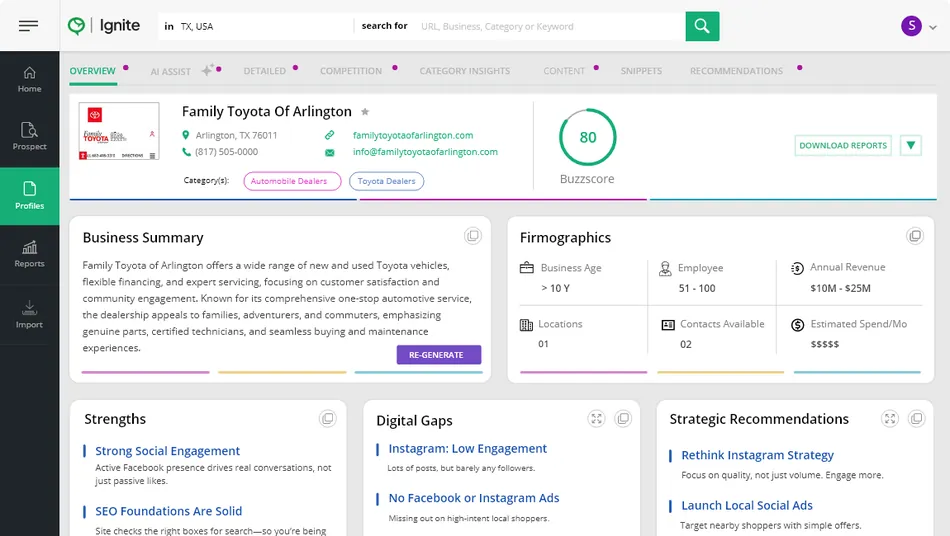
Ignite serves sales teams at marketing service providers that sell to SMBs. The Leads Agent scores prospects against BuzzBoard’s database and ranks them by fit. The Sales Agent generates outreach cadences (email, call script, SMS, voicemail) based on each prospect’s digital gaps. BuzzBoard claims Ignite cuts sales research from 45 minutes to 2 minutes per account and delivers a 3x lift in open and reply rates.
Source: G2
Per-seat pricing means your cost scales with the number of reps using the platform. For large sales teams, this metric is predictable. For smaller teams hoping to test with one or two reps, the lack of published pricing makes it impossible to gauge whether a pilot is affordable without a call.
| Ignite | |
|---|---|
| Pros | Cons |
| ✅ Per-seat metric aligns with sales team sizing | ❌ No published price, even for a single seat |
| ✅ Includes Chrome Extension for field reps | ❌ CRM integrations listed as add-ons, not bundled |
| ✅ 30M+ SMB profiles with 6,000+ signals | ❌ Data accuracy concerns noted by Capterra reviewers |
| ✅ Same-day activation via Chrome Extension | ❌ No self-serve trial to test fit scoring accuracy |
The Bottom Line 👉 Ignite is the most accessible entry point for organizations that want to start with sales intelligence before expanding into fulfillment or retention. But without pricing visibility, even qualifying budget fit requires a sales call.
Zylo: AI Fulfillment Engine (Priced Per Marketing Assets and Customers)
| Feature | Details |
|---|---|
| Pricing Metric | Per marketing assets and customers (custom-quoted) |
| Target Team | Fulfillment and marketing operations |
| Core Agents | Brand Kit, Website, Social Media, Reviews, Social Ads, Search Ads, Blog, Email |
| Setup Time | 1 day, no dev work required |
| Time to First Campaign | 48 hours |
| Claimed Outcome | 2.2x fulfillment throughput |
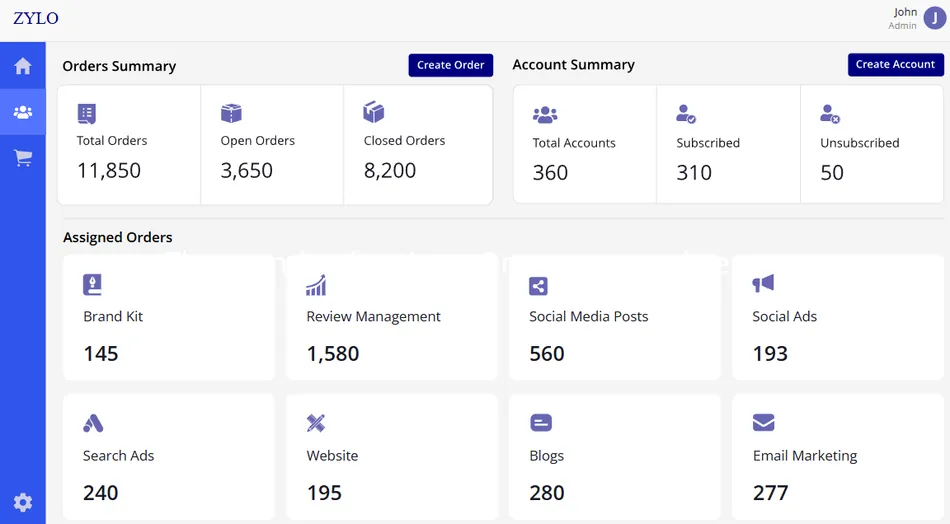
Zylo is the fulfillment module. It’s built for teams that produce marketing assets (ads, social posts, websites, blog content, email campaigns, review responses) across hundreds or thousands of SMB clients. Eight AI agents handle different content channels, and BuzzBoard publishes specific benchmarks: cost per campaign asset dropped from $120 to $45, assets per designer per week rose from 22 to 65, and QA failures fell from 4.7 to 0.8 per 1,000 assets.
Source: Buzzboard
Usage-based pricing tied to asset volume and customer count means your bill grows with your client base. BuzzBoard calls this “usage-based pricing with unlimited seats”, which avoids the per-user tax that penalizes growing teams. The trade-off is unpredictability: if your asset production spikes, so does the invoice.
| Zylo | |
|---|---|
| Pros | Cons |
| ✅ Unlimited seats (no per-user penalty) | ❌ No published rates per asset or per customer |
| ✅ Eight channel-specific AI agents | ❌ Ads and social platform integrations are add-ons |
| ✅ One-day setup with no dev work | ❌ Performance issues under load noted by reviewers |
| ✅ Human-in-the-loop via Canva integration | ❌ Email Agent still appears to be in development |
The Bottom Line 👉 Zylo’s pricing model makes sense for high-volume fulfillment teams: you pay for what you produce, not how many people produce it. But without rate cards, budgeting requires a direct conversation about your specific production volumes.
Ember: Customer Success Automation (Priced Per Accounts Under Management)
| Feature | Details |
|---|---|
| Pricing Metric | Per accounts under management (custom-quoted) |
| Target Team | Customer success and account management |
| Core Agents | Onboarding Agent, Account Management Agent |
| Optional Agent | Strategy Agent (custom reports, nurture sequences) |
| CRM Integrations | Salesforce, MS Dynamics |
| Claimed Outcome | 28% retention uplift |
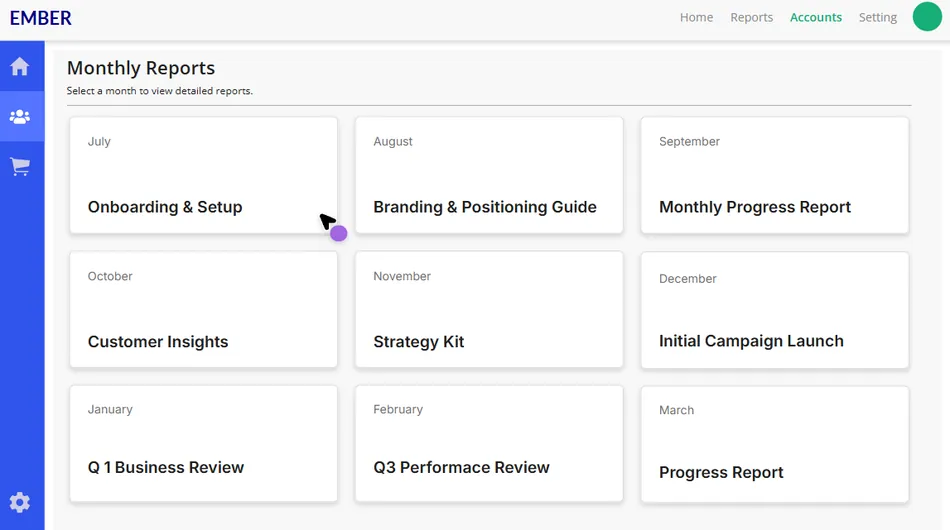
Ember targets customer success teams that manage large portfolios of SMB clients. The Onboarding Agent automates intake briefs with 90%+ fill rates before the first call, while the Account Management Agent generates monthly progress reports, competitive benchmarks, and renewal readiness briefs. BuzzBoard reports 24% lower churn and 21% growth in expansion revenue from Ember users.
Source: Buzzboard
Per-account pricing is unusual in this category. It ties cost to your client portfolio size rather than your internal headcount, which is logical for a retention tool. If you manage 500 SMB accounts and Ember reduces churn by even a fraction of what BuzzBoard claims, the ROI math can work. But the specifics of what “per account” actually costs remain behind the sales conversation.
| Ember | |
|---|---|
| Pros | Cons |
| ✅ Per-account pricing aligns with CS team economics | ❌ No published per-account rates |
| ✅ Onboarding automation with 90%+ intake fill rates | ❌ Strategy Agent may be separately priced |
| ✅ Sales-call-to-onboarding translation | ❌ Limited CRM support (Salesforce and Dynamics only) |
| ✅ Predictive upsell detection built into monthly workflow | ❌ No public documentation or help center |
The Bottom Line 👉 Ember’s per-account model fits customer success teams at scale, and the claimed retention and upsell metrics are strong. But buyers managing fewer than a few hundred accounts should assess whether the enterprise pricing justifies the investment.
Hidden Costs and Add-Ons
BuzzBoard’s pricing page makes one thing clear: the base subscription for any module is not the complete cost. Quotes are “customized to your scale, automation needs, and integration depth”, and several cost layers sit on top of the base product.
Integrations Are Add-Ons, Not Included
The pricing page lists these as common add-ons billed separately:
- CRM integrations (Salesforce, HubSpot, Dynamics)
- Email client integrations
- Canva integration
- Ads platforms API integrations
- Stock image library
- Social platforms API integrations
For most fulfillment teams, CRM connectivity and ads platform access are not optional. If your workflow depends on pushing data to Salesforce or running Google Ads through Zylo, those integrations add to your contract value. The pricing page does not specify whether each integration carries a flat fee, a percentage surcharge, or is bundled at certain commitment levels.
Individual AI Agents May Be Separately Licensed
The pricing page tells buyers to “choose your entry point and add AI agents, integrations, and support”. This suggests the base product may not include all available agents. Zylo lists eight agents (Brand Kit, Website, Social Media, Reviews, Social Ads, Search Ads, Blog, Email), and it is not clear whether all eight come with a standard Zylo contract or whether each agent is a separate line item.
Support Tiers Likely Exist Above Baseline
The pricing page states that “each configuration includes enterprise-grade security, APIs, and support,” but the quote builder also lists support as something buyers can “add.” This implies tiered support options beyond the baseline. Dedicated account management, faster response times, or onboarding assistance could carry additional costs.
Contract and Implementation Costs Are Not Disclosed
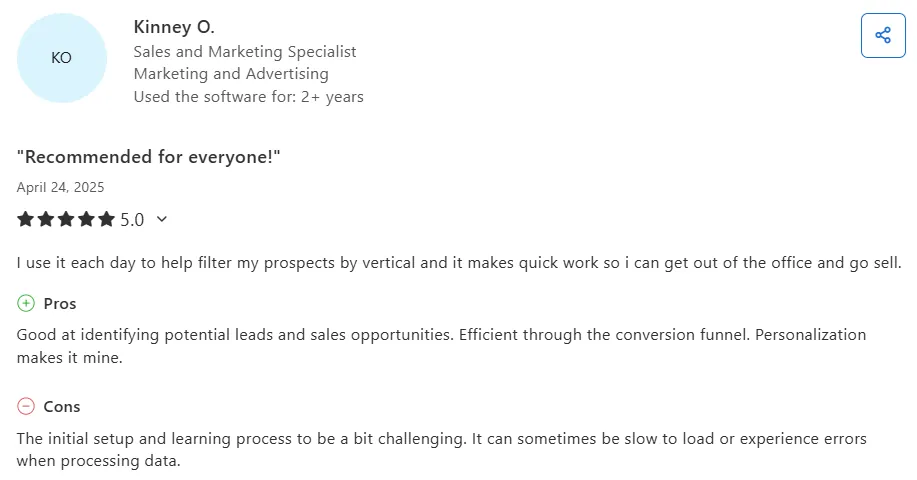
BuzzBoard publishes no information about minimum contract values, implementation fees, onboarding costs, or training packages. Given the enterprise positioning and the learning curve noted by Capterra reviewers, buyers should budget for an implementation phase beyond the subscription itself.
Source: Capterra
Free Trial and Free Plan
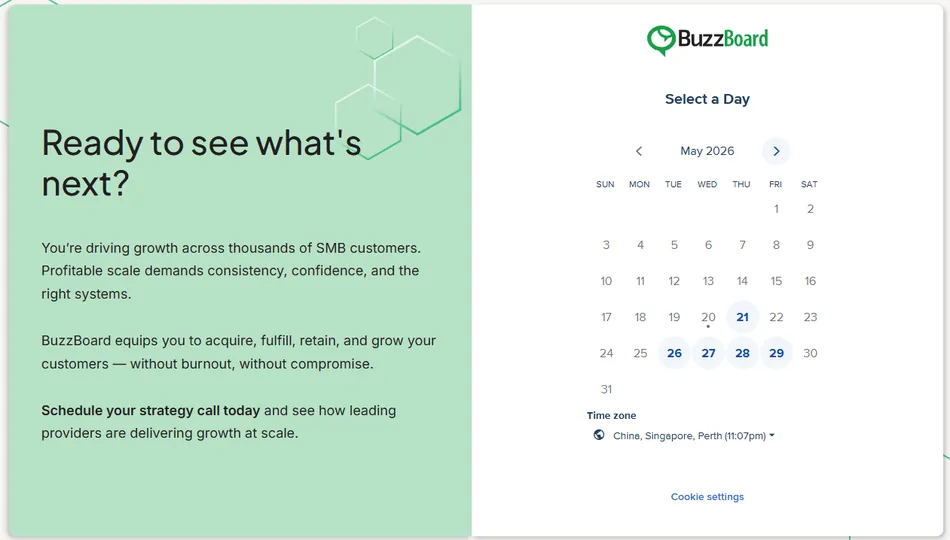
BuzzBoard does not offer a free plan or a self-serve free trial. There is no self-service entry point of any kind. The only path to evaluation is a live demo or sales conversation through the “Talk to Us” form on the website.
A legacy free trial page existed in earlier versions of BuzzBoard’s product, but BuzzBoard retired it as the platform moved to enterprise-only positioning. There is also a free small business digital audit tool that BuzzBoard launched in 2024, which lets users assess an individual SMB’s digital presence. This is a lead generation tool, not a product trial: it shows BuzzBoard’s data quality on a single business but does not give access to the Ignite, Zylo, or Ember workflows.
For teams evaluating BuzzBoard, this means the evaluation process is sales-assisted. You cannot independently test data accuracy, agent output quality, or platform speed before engaging with the sales team and, presumably, signing a contract.
Source: Buzzboard
Pricing for Different Team Sizes
BuzzBoard’s custom-quote model means pricing scales differently depending on which module you buy and how your organization is structured. Here’s how the three pricing metrics likely map to different buyer profiles:
Source: Buzzboard
- Boutique Agencies (Under 100 SMB Clients)
BuzzBoard is not designed for this segment. The platform targets high-volume marketing service providers serving thousands of SMB customers, and the enterprise-only sales process reflects this. Agencies managing fewer than 50 to 100 accounts will likely find the pricing out of proportion to the benefit. Smaller agencies would do better assembling separate tools for prospecting, content creation, and account management.
- Mid-Market Providers (100 to 1,000 SMB Clients)
This is the transition zone. Providers at this scale have enough volume to benefit from Zylo’s fulfillment automation and Ember’s retention workflows, but may lack the procurement resources to navigate a long enterprise sales process. The per-asset (Zylo) and per-account (Ember) pricing metrics start to make economic sense at this volume, since adding one more client costs incrementally rather than requiring additional headcount. But BuzzBoard’s pricing page offers no visibility into what this actually costs at 200 or 500 accounts.
- Enterprise Providers (1,000+ SMB Clients)
This is BuzzBoard’s target market. Organizations managing thousands of SMB accounts across sales, fulfillment, and retention will see the strongest fit between their operating model and BuzzBoard’s pricing structure. At this scale, per-seat (Ignite), per-asset (Zylo), and per-account (Ember) metrics each map to a distinct budget owner within the organization, and the shared data layer eliminates the integration costs of running separate tools. Enterprise buyers also have the negotiating leverage to structure contracts around volume commitments and multi-module bundling.
- Individual Sales Reps or Small Teams
BuzzBoard is not built for individual users. There is no individual plan, no monthly subscription, and no low-cost entry tier. Sales reps at smaller organizations looking for SMB prospecting intelligence would do better with tools that offer transparent, self-serve pricing.
Is BuzzBoard Worth the Price?
Without published prices, the honest answer is: it depends on what number comes back from the sales conversation. But the value question can still be framed around what you’re trading off.
What you get that’s hard to replicate elsewhere:
BuzzBoard’s core advantage is its database of 30 million SMB profiles with 6,000+ signals per business, refreshed on a 30-day cycle. No general-purpose sales intelligence platform offers this depth of SMB-specific digital presence data. If your sales process depends on knowing each prospect’s website health, ad spend, review sentiment, and competitive position before a call, BuzzBoard’s data stands apart. Sharing that data across sales (Ignite), fulfillment (Zylo), and retention (Ember) in one platform eliminates the context loss that comes from switching between separate tools.
Source: Buzzboard
BuzzBoard publishes specific benchmarks: fulfillment costs reduced by 62.5%, sales research time cut by 94%, churn reduced by 24%. If those numbers hold at your volume, the platform could pay for itself through headcount efficiency alone. One testimonial describes redeploying 6 production FTEs while tripling monthly campaign output.
What should give you pause:
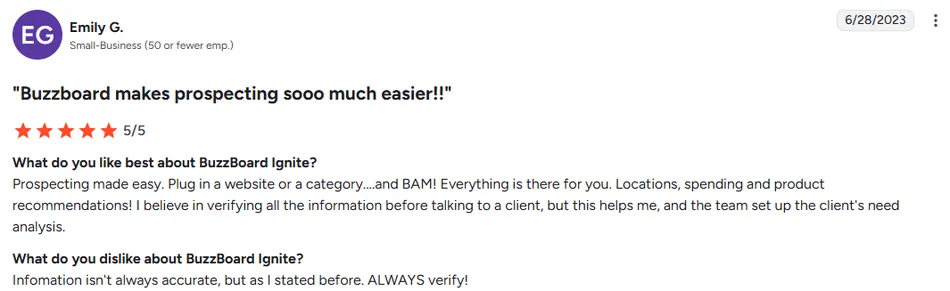
The data accuracy concern is real. Capterra reviewers flag that BuzzBoard’s data can contain inaccuracies, and since the entire value proposition rests on SMB profile accuracy, errors directly undermine the sales process the platform is designed to support. Users report needing to verify data independently, which adds back some of the research time the product claims to eliminate.
Source: G2
The learning curve is steep. Three interconnected modules, multiple AI agents, CRM integration, and brand guardrail configuration all require real ramp time. If your team doesn’t have the patience or resources for a multi-week onboarding, you’ll wait longer for results than BuzzBoard’s marketing suggests.
The lack of pricing transparency is itself a cost. Enterprise software sales consume internal resources: discovery calls, vendor evaluations, procurement reviews, contract negotiations. For organizations comparing three or four options, BuzzBoard’s opaque pricing adds friction that platforms with published pricing don’t impose.
The value threshold:
BuzzBoard is worth it if your organization manages enough SMB accounts that the per-seat, per-asset, or per-account economics generate clear ROI at the quoted price, and if the data accuracy holds up for your sales and fulfillment workflows after a proof-of-concept. It is not worth it if you’re paying enterprise prices for a volume that could be handled by a combination of cheaper, more transparent tools.
Final Verdict: BuzzBoard Pricing
BuzzBoard is an AI platform built for a specific buyer: the enterprise marketing service provider that sells to, fulfills for, and retains thousands of SMB clients. Its three modules (Ignite for sales, Zylo for fulfillment, Ember for retention) share a common data layer of 30 million SMB profiles, and its pricing metrics (per seat, per asset, per account) match how high-volume providers operate. The platform’s SOC 2 Type II compliance and CRM integrations meet enterprise procurement requirements.
Is BuzzBoard’s pricing right for you? If you’re a telecom company, large digital agency, or media company managing 500 or more SMB accounts, and you’ve hit the headcount ceiling on sales research, content production, or account management, BuzzBoard addresses a real problem. Request a quote with specific volume numbers (seats needed, monthly asset volume, accounts under management) so you can evaluate the ROI against your current costs. If you’re a smaller agency or a team that needs price transparency before committing to a sales process, BuzzBoard’s enterprise-only model will feel like a barrier, and tools with published pricing will let you move faster.
Request a custom quote from BuzzBoard here.
BuzzBoard Pricing FAQ
Does BuzzBoard publish any prices on its website?
No. BuzzBoard uses a custom-quoted model with no public pricing tiers, rate cards, or starting prices. The only way to get a number is through a sales conversation via the “Talk to Us” form on their pricing page. Every quote is customized based on your scale, the modules you need, integration requirements, and support level.
Does BuzzBoard offer a free trial?
BuzzBoard does not offer a free trial or a free plan. There is no self-serve entry point. Evaluation requires a live demo with the sales team. BuzzBoard does offer a free small business digital audit tool that shows its SMB data quality on individual businesses, but this is a lead generation tool, not a product trial.
How is BuzzBoard priced for each module?
BuzzBoard uses three pricing metrics depending on which module you buy. Ignite (sales intelligence) is priced per seat. Zylo (fulfillment) is priced per marketing assets and customers served. Ember (customer success) is priced per accounts under management. You can start with one module and add others over time.
Are integrations included in BuzzBoard’s base pricing?
No. The pricing page lists CRM integrations, email client integrations, Canva integration, ads platform APIs, stock image libraries, and social platform APIs as common add-ons billed on top of the base product. Since most teams need at least CRM connectivity to use the platform effectively, integration costs should be factored into any budget estimate.
What size company is BuzzBoard built for?
BuzzBoard targets high-volume marketing service providers managing hundreds to thousands of SMB client accounts. This includes digital marketing agencies, media companies, telecom providers with SMB divisions, and outsourced marketing firms. It is not designed for individual users, small agencies with fewer than roughly 50 clients, or SMBs themselves.
What do reviewers say about BuzzBoard?
BuzzBoard holds a 4.3 out of 5 rating from 143 reviews on Capterra and approximately 168 reviews on G2. Users praise the SMB data depth and speed of prospect research. Common criticisms include data accuracy issues, a steep learning curve during initial setup, and occasional slowness when processing data at volume.
Can I buy just one BuzzBoard module, or do I need all three?
BuzzBoard lets buyers start with a single module. The pricing page describes the structure as “one platform, three entry points,” so you can begin with Ignite for sales, Zylo for fulfillment, or Ember for retention and expand later. Each module shares the same underlying SMB data layer, so data carries over when you add modules.
How long are BuzzBoard contracts?
BuzzBoard does not disclose contract terms publicly. Given the custom-quoted enterprise model and the sales-assisted purchase process, contract structures are negotiated individually. Buyers should expect enterprise-style agreements rather than month-to-month self-serve subscriptions. Ask about contract length, auto-renewal clauses, and cancellation terms during the quoting process.