Choosing between Lemlist and Woodpecker for cold email outreach comes down to five questions:
- Do you need multichannel outreach across email, LinkedIn, WhatsApp, and phone, or is email with basic LinkedIn steps enough?
- Are you a sales team running your own outreach, or an agency managing campaigns for multiple clients?
- Do you want a built-in lead database with waterfall enrichment, or would you rather bring your own data?
- Is per-seat pricing acceptable, or do you prefer contact-based pricing with unlimited team members?
- How important is AI personalization versus simplicity and fast campaign setup?
In short, here’s what we recommend:
👉 Lemlist is the multichannel outreach platform for sales teams that want to reach prospects across email, LinkedIn, WhatsApp, and phone from a single sequence. Its 600M+ contact database with waterfall enrichment from 8+ data providers lets teams find and verify leads without a separate tool.
AI Variables clean data, generate personalized openers, and clone your voice for LinkedIn voice notes, giving reps the capacity to personalize at scale. The catch: per-seat pricing starting at $79/user/month adds up for larger teams, and Lemlist’s sending policy explicitly prohibits agencies sending on behalf of clients.
👉 Woodpecker is the deliverability-focused cold email platform for agencies and lean B2B teams that want unlimited team members, unlimited connected email accounts, and a dedicated Agency Panel for managing client campaigns from one dashboard.
Contact-based pricing starts with a free plan covering 500 contacted prospects/month, and paid plans scale by volume rather than headcount. Free email verification (via Bouncer), free warm-up, and Adaptive Sending that throttles volume to prevent inbox blocks make deliverability a default, not a configuration task.
The trade-off: no phone dialer, no WhatsApp, and LinkedIn automation is a $29/month add-on per account with less depth than Lemlist’s native integration.
You can explore Lemlist or Woodpecker directly, or read on for our full comparison.
Lemlist vs Woodpecker at a glance
| Lemlist | Woodpecker | |
|---|---|---|
| Core Focus | Multichannel sales outreach | Deliverability-first cold email |
| Starting Price | $79/user/month (Email Pro) | Free plan; paid from $35/month |
| Pricing Model | Per-seat | Per contacted prospect |
| Lead Database | 600M+ contacts, waterfall enrichment | 1B+ contacts via Lead Finder add-on |
| Channels | Email, LinkedIn, WhatsApp, phone | Email, LinkedIn (add-on) |
| AI Personalization | AI Variables, voice cloning, images | OpenAI email writer |
| Warm-up | Included (lemwarm Essential) | Included (Mailivery/Warmy) |
| Team Members | Per-seat charge | Unlimited, free |
| Email Accounts | 3-5 per seat (by plan) | Unlimited, free |
| Agency Support | Prohibited for third-party sending | Dedicated Agency Panel |
| Free Trial | 14 days, no credit card | 14 days + permanent free plan |
| Best For | Sales teams wanting multichannel + data | Agencies and teams prioritizing deliverability |
The core difference: Multichannel reach vs deliverability-first simplicity
Lemlist started in 2018 as the tool that could embed personalized images and videos in cold email. That visual personalization hook attracted an early following among sales professionals.
Since then, Lemlist has expanded into a full prospecting platform: a built-in lead database, multichannel sequences across four channels, AI personalization, and intent signals. The company is bootstrapped under parent company lempire, profitable, and run by 90+ people across 10+ countries.
Lemlist’s philosophy assumes every prospect responds to a different channel. Some reply to email, some to LinkedIn, some only pick up the phone. The platform coordinates all those touchpoints in one automated sequence, with behavioral branching that adapts the next step based on what the prospect did.
Woodpecker launched in 2015 in Wroclaw, Poland, when co-founders Mateusz Tarczyński and Maciej Cieśla built cold email automation for a fitness app’s beta outreach and realized the automation itself was the product.
The company went public on the Warsaw Stock Exchange in 2021 and upgraded to the GPW Main Market in 2024 (ticker: WPR), making it the only publicly listed company in the cold email category. A team of 60+ employees serves 4,500+ B2B clients in 110 countries.
Woodpecker’s philosophy centers on email deliverability. Every feature (Adaptive Sending, free Bouncer verification, campaign-copy warm-up) exists to keep emails landing in the primary inbox. The platform added LinkedIn automation and a lead database over time, but cold email remains the core, and the agency use case, with its dedicated Agency Panel, is where Woodpecker is strongest.
Email deliverability: Both strong, different approaches
Both platforms treat deliverability as a first-class concern, but they solve it differently.
Lemlist ships with lemwarm, an email warm-up tool built on a network of 10,000 users across 20,000+ domains in 150+ countries. The Essential tier (reputation maintenance and monitoring) comes free with every paid plan. The Smart tier ($20/user/month add-on) groups senders into clusters by industry, target audience, and location for more relevant warm-up interactions.
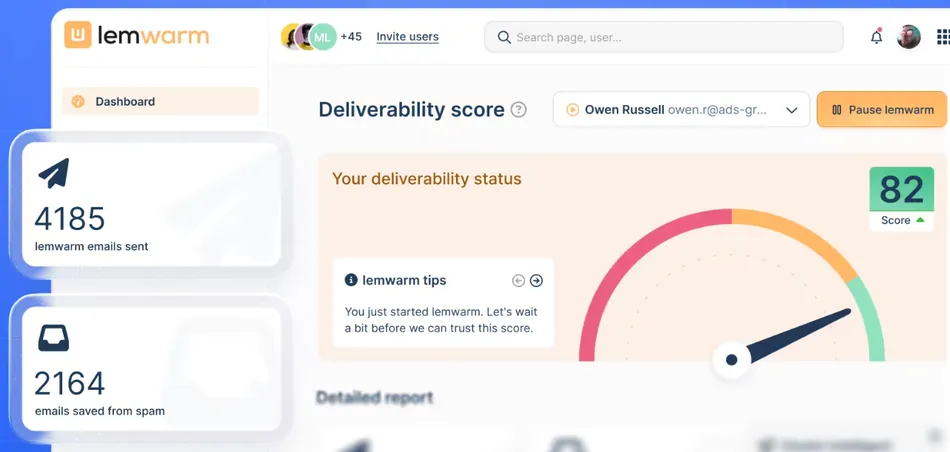
Source: Lemlist Lemwarm
Beyond warm-up, Lemlist offers a Deliverability Hub dashboard tracking delivery rate, bounce rate, inbox rate, and spam count, broken down by sender-recipient provider pair. Matching ESP routes emails to recipients using the same email service provider, improving authentication pass rates.
Inbox rotation distributes leads across multiple sending accounts per campaign for both email and LinkedIn. Spendesk reported a 96% deliverability rate after adoption.
Woodpecker builds deliverability into the platform’s default behavior with no configuration required. Adaptive Sending runs in the background, monitoring outbound volume per mailbox and throttling by 50% for 24 hours when volume approaches provider limits. Woodpecker’s internal data (comparing 2,900+ inboxes) shows that accounts with Adaptive Sending experienced 2.4x fewer provider-imposed blocks.
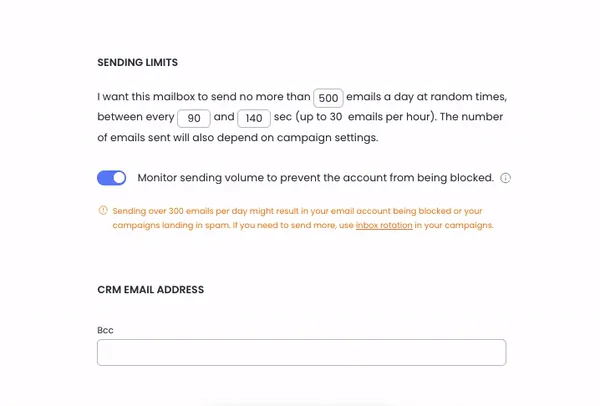
Source: Woodpecker Adaptive Sending
Every send triggers automatic email verification via Bouncer at no extra cost. Warm-up comes bundled through Mailivery or Warmy, with a distinctive feature: users can feed their actual campaign copy into the warm-up process, training inbox provider algorithms to associate that copy with positive engagement before the campaign launches. Inbox rotation supports up to 100 email accounts per campaign.
A Domain Audit checks SPF and DKIM records when an email account is connected. Woodpecker also sells domains and email accounts with SPF, DKIM, and DMARC pre-configured inside the platform.
Both platforms take deliverability seriously. Lemlist’s advantage is its larger warm-up network and Matching ESP routing. Woodpecker’s advantage is that its safety mechanisms are always on by default, require no configuration, and include campaign-copy warm-up (a feature Lemlist doesn’t offer).
Multichannel outreach: Lemlist goes wider
This is where the platforms diverge most.
Lemlist supports four outreach channels in a single sequence: email, LinkedIn (profile visits, connection requests, direct messages, voice notes), phone calling (built-in VoIP dialer with AI call summaries), and WhatsApp ($20/user/month add-on).
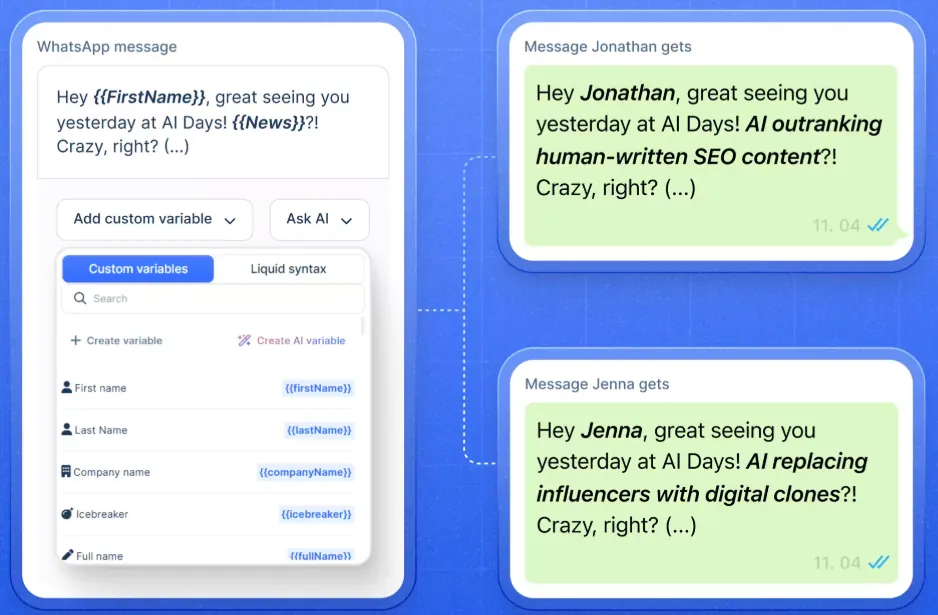
Source: Lemlist Whatsapp Messaging
LinkedIn automation runs natively via Chrome extension, including AI voice cloning for personalized voice notes. Advanced conditions reroute contacts based on behavior: a lead who accepts a LinkedIn invite gets a direct message; a lead who doesn’t gets routed back to email.
All replies across channels surface in a Unified Inbox supporting up to 15 email addresses per user. Adding LinkedIn to outreach reportedly generates 2.5x more replies compared to email alone.
Woodpecker supports email natively and LinkedIn as a $29/month add-on per LinkedIn account. The LinkedIn integration offers four action types: profile visits, connection requests, direct messages, and InMail.
These can be embedded as steps within email sequences, with conditions that branch based on whether the prospect accepted a connection request. A/B testing supports up to 5 variants per LinkedIn message step.
Woodpecker also supports call and SMS tasks and manual LinkedIn tasks as reminders within sequences, but these are logged steps for the rep to complete manually, not automated actions. There is no built-in phone dialer, no VoIP, no WhatsApp channel, and no voice note capability.
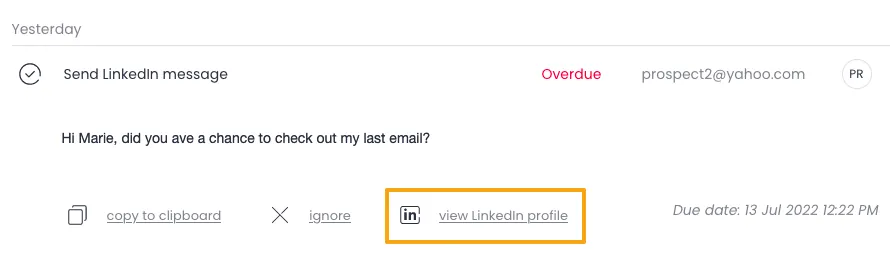
Source: Woodpecker Manual LinkedIn Tasks
For teams that rely on multichannel touchpoints, Lemlist offers more execution. For teams focused on cold email with occasional LinkedIn support, Woodpecker covers the basics at lower cost.
Lead database and enrichment: Different scales, different models
Lemlist offers a 600M+ contact database with 65M+ company accounts searchable by job title, seniority, industry, country, and company attributes.
The key differentiator is waterfall enrichment: when you enrich a contact, Lemlist queries 8+ data providers sequentially (including Prospeo, Icypeas, Dropcontact, and Datagma) until it finds a verified email, reaching an 80% email found rate compared to a single-provider average of 30-60%. Every email found is double-verified.
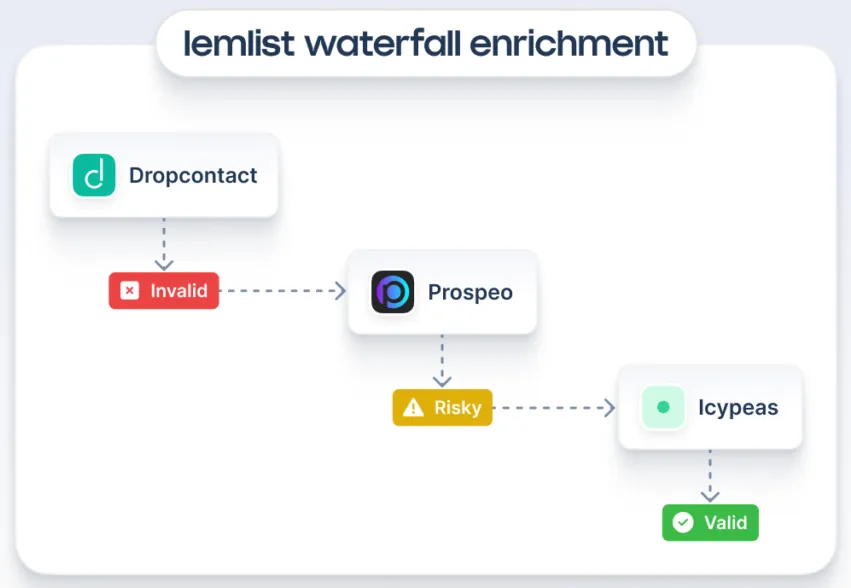
Source: Lemlist Waterfall Enrichment
Email enrichment costs 5 credits ($0.05) per verified result; phone numbers cost 20 credits ($0.20). You pay only for deliverable or risky emails. Monthly free allotments are 200 credits on Email Pro and 400 on Multichannel Expert. Lemlist also offers Intent Signals that monitor triggers like website visits and LinkedIn engagement, with AI-generated icebreakers.
Woodpecker provides access to over 1 billion contacts through its Lead Finder add-on. You search through two tabs: a Leads tab with individual filters (job title, country, industry, seniority) and a Companies tab for company-level research.
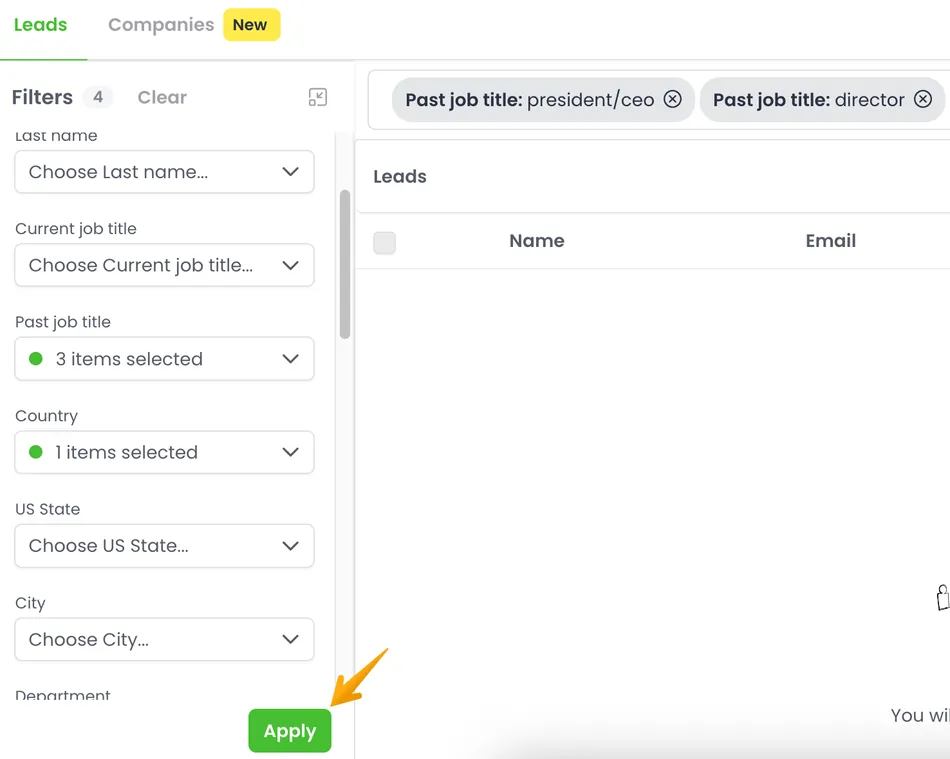
Source: Woodpecker Lead Finder
Found leads push directly into campaigns without CSV exports. 400 credits come free each month, with viewing a company costing 2 credits, viewing a lead costing 1 credit, and finding an email costing 1.5 credits.
The difference: Lemlist’s waterfall enrichment queries multiple providers for higher find rates and includes intent signals. Woodpecker’s Lead Finder works as a search engine connected to a single data provider, with no enrichment layer (no technographic data, intent signals, or job change triggers). Teams needing richer enrichment with Woodpecker typically connect third-party tools like Clay or Persana AI.
AI personalization: Lemlist leads by a wide margin
Lemlist treats AI as a data layer, not just a text generator. AI Variables operate inside the lead table, letting users create custom AI columns that clean job titles, classify leads by ICP fit, segment by company size, or generate personalized opening lines.
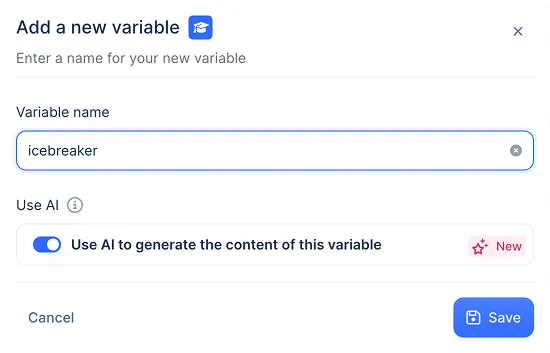
Source: Lemlist AI Variables
Users choose the AI provider per column (OpenAI, Claude, Perplexity, or Google), set temperature, and chain multiple AI columns into pipelines saved as reusable templates.
Personalization extends beyond text. Dynamic images embed prospect-specific variables (company logos, website screenshots) into email bodies. Personalized landing pages customize content per lead with integrated Calendly and HubSpot CTAs.
AI voice notes clone the user’s voice from a 2-minute recording and generate LinkedIn voice messages with dynamic variables at scale. The Campaign Generator builds a personalized multi-step sequence from a company URL in minutes, supporting 70+ languages. AI features are included in all paid plans.
Woodpecker offers an OpenAI integration in the email editor for AI-assisted copywriting and an AI Video product that generates personalized videos with AI name customization. AI response sentiment detection categorizes replies by interest level. These are useful features, but they operate at the message level rather than as a data transformation layer.
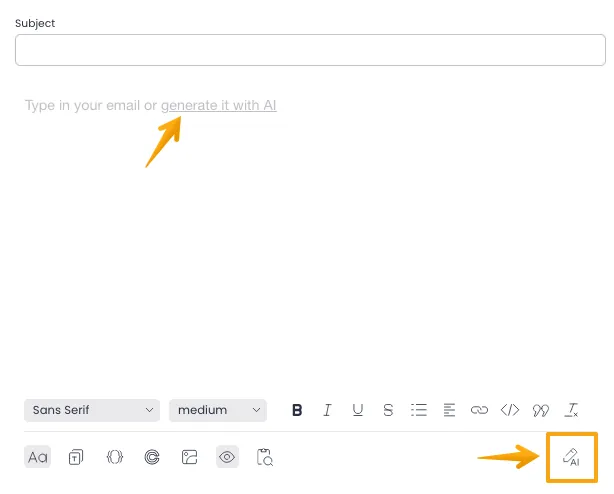
Source: Woodpecker OpenAI Integration
Woodpecker’s custom fields and Spintax support allow copy variations, and Liquid Syntax provides conditional logic within emails. But there is no equivalent to Lemlist’s multi-provider AI column pipelines, dynamic image personalization, voice cloning, or personalized landing pages.
For teams that want AI embedded in lead research and personalization, Lemlist is in a different category. For teams that want AI writing assistance in an email editor, Woodpecker covers the essentials.
Agency and team management: Woodpecker was built for this
Woodpecker offers a dedicated Agency Panel with one of the most developed agency management layers in the cold email category. It provides a single dashboard for all client accounts, campaigns, and reports. Guest Viewer access lets clients review their own campaign stats without full login credentials.
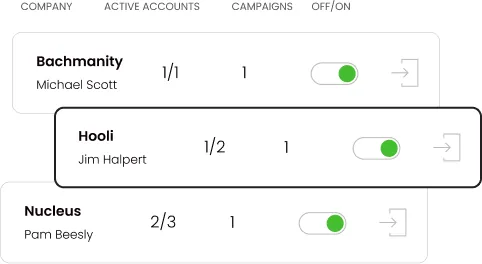
Source: Woodpecker Agency Panel
Global domain blacklisting cascades safety settings across every client account at once. White-label notification emails are included by default, and an optional white-label reporting app ($5/month per active client) lets agencies host branded reports on their own domain.
A “to be contacted” pipeline bar shows which clients’ campaigns are about to run out of prospects before results suffer. A dedicated Agency API supports programmatic client management. Clients connect their own mailboxes via invitation, so no password sharing is required. And with unlimited team members at no extra cost, agencies scale their teams without multiplying software costs.
Veth Group uses the Agency Panel to run roughly 1,000 client appointments per month, claiming SDR-cost savings of 50%.
Lemlist takes a different position on agencies. Its Sending Policy explicitly prohibits sending emails “in the name and on behalf of third-parties (including their own customers)”. Lead generation agencies and firms running client outreach through a single Lemlist account are not permitted.
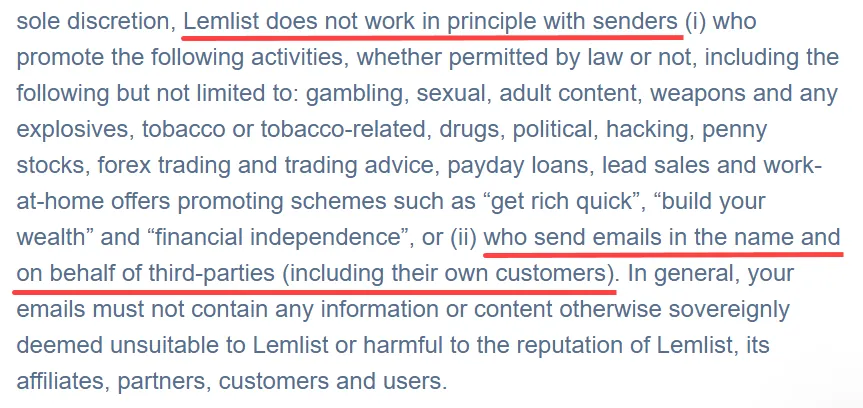
Source: Lemlist Sending Policy
Lemlist offers a Partner program and expert marketplace for agencies that want to recommend the tool to clients, but the clients must run their own accounts.
For team management within a single organization, Lemlist provides 5 guest seats per account on Email Pro, custom user roles on Enterprise, and CRM extensions for Salesforce and HubSpot (Enterprise tier). Woodpecker includes unlimited team members on every plan.
For agencies, this comparison is straightforward: Woodpecker is designed for the use case; Lemlist’s terms of service prohibit it.
Pricing comparison
The pricing structures differ fundamentally, which makes direct comparison tricky.
Lemlist uses per-seat pricing:
| Plan | Monthly | Annual (~20% off) |
|---|---|---|
| Email Pro | $79/user/month | $63/user/month |
| Multichannel Expert | $109/user/month | $87/user/month |
| Enterprise | Custom | Custom (annual, min 5 seats) |
Email Pro includes up to 3 sending email addresses per seat and 200 free enrichment credits/month. Multichannel Expert adds LinkedIn automation, a built-in call dialer, unified inbox, and 5 sending addresses per seat with 400 free credits/month.
Add-ons increase the per-user cost: WhatsApp automation ($20/user/month), Smart lemwarm ($20/user/month), Claap AI meeting agent ($60/user/month), and additional sending email addresses ($9/email/month). A five-person sales team on Multichannel Expert with WhatsApp runs $645/month annually ($129/user x 5).
The 14-day free trial gives full Multichannel Expert access with no credit card required. After the trial, a freemium plan preserves account access but disables campaign sending.
Woodpecker uses contact-based pricing:
| Contacted Prospects/Month | Approximate Monthly Price |
|---|---|
| 500 (Free plan) | $0 |
| 500 (Paid) | $35 |
| 2,000+ | Scales progressively |
The pricing page shows a rate of roughly $7 per 100 contacted prospects monthly. Annual plans save 33%. Every paid plan includes unlimited team members, unlimited email accounts, unlimited A/B tests, catch-all verification, inbox rotation, and Adaptive Sending.
Add-ons layer on top: LinkedIn outreach ($29/month per LinkedIn account), Agency Panel ($27/month per active client), additional warm-ups ($5/month per email account), and Lead Finder credits ($28+/month for 2,000 credits). API access is also a separate paid add-on.
The free plan includes 500 contacted prospects/month, 6,000 emails/month, 2 warm-ups, and 400 Lead Finder credits, making it a functional ongoing option for small-scale outreach.
Cost comparison for a five-person team contacting 2,000 prospects/month:
With Lemlist on Multichannel Expert (annual): roughly $435/month ($87 x 5 seats). With Woodpecker at 2,000 contacted prospects plus LinkedIn for two accounts: the base plan plus $58 in LinkedIn add-ons. The exact Woodpecker total depends on the prospect tier, but it will typically cost less than Lemlist for the same team size, with fewer channels and less AI capability.
The trade-off: Lemlist charges more but includes multichannel execution, waterfall enrichment, and AI personalization per seat. Woodpecker charges less per volume unit but gates LinkedIn, API access, and lead data behind add-ons that can add up.
Who should choose Lemlist?
Choose Lemlist if:
- You’re a sales team (SDRs, AEs, founders) running your own outreach, not sending on behalf of clients
- Multichannel sequences across email, LinkedIn, WhatsApp, and phone are central to your prospecting strategy
- You want a built-in lead database with waterfall enrichment from 8+ providers at an 80% find rate
- AI personalization (dynamic images, voice cloning, personalized landing pages, AI Variables) matters for your reply rates
- You need intent signals that trigger outreach based on website visits or LinkedIn engagement
- Your team uses Salesforce or HubSpot and wants CRM extensions (Enterprise tier)
- You value a practitioner-built UX. ElevenLabs’ GTM lead noted the Sequence Builder “has been built by people who really understand prospection”
Lemlist is strong for B2B SaaS companies between 10 and 500 employees with active outbound pipeline generation. Case studies from ElevenLabs (grew outbound from 5% to 30% of pipeline), Spendesk (2x outbound meetings per AE with 96% deliverability), and RightMarket (10x more sales meetings) show the platform performing well for growth-stage teams with dedicated outbound efforts.
Who should choose Woodpecker?
Choose Woodpecker if:
- You run a lead generation agency managing campaigns for multiple clients (Lemlist’s terms prohibit this)
- You want unlimited team members and unlimited connected email accounts without per-seat charges
- Deliverability is your top priority, and you prefer safety mechanisms that work automatically
- You need a permanent free plan for small-scale outreach or extended evaluation
- Your budget is tighter and you want to pay based on prospect volume rather than team size
- You’re a recruiter doing candidate sourcing and BD outreach via automated email sequences
- You want to buy sending infrastructure (domains and email accounts with pre-configured SPF/DKIM/DMARC) inside your outreach tool
- Developer-friendly features like an MCP Server, CLI, and public API matter for your workflow
Woodpecker serves lead generation agencies, small B2B sales teams, recruiters, and business owners doing their own prospecting.
Veth Group runs 1,000 client appointments per month through the Agency Panel. Ecom Capital went from zero meetings to 2 qualified calls per day within 21 days. ProfitWell’s Patrick Campbell credited Woodpecker as essential to building the company: “No other cold email tool allows you to scale one-to-one sales conversations with prospects in such a personalized way.”
Final verdict
Lemlist and Woodpecker are both capable cold email platforms, but they serve different buyers.
Lemlist is the broader outreach platform. It gives sales teams a built-in lead database, multichannel sequences across four channels, AI personalization from data cleaning to voice cloning, and behavioral branching that adapts campaigns based on prospect actions.
The cost is higher per user, the learning curve is steeper, and agencies are excluded by policy. But for teams that want everything from lead sourcing to booked meeting in one tool, Lemlist covers more ground.
Woodpecker is the deliverability-focused email platform for agencies and cost-conscious teams. Its always-on safety features, contact-based pricing with unlimited seats, dedicated Agency Panel, and free infrastructure (verification, warm-up, team members, email accounts) make it the natural choice for operators who manage multiple client accounts or want to land in the inbox without configuring anything.
The trade-off is narrower channel coverage, less AI capability, and add-on costs that can accumulate.
The decision often maps to one question: are you a sales team running your own multichannel outreach, or an agency (or lean team) focused on cold email at scale? Lemlist serves the first. Woodpecker serves the second. Both deliver emails to the inbox. They just approach the rest of the workflow differently.
Try Lemlist or Woodpecker to see which fits your outreach needs.
Lemlist vs Woodpecker FAQ
What is the main difference between Lemlist and Woodpecker?
Lemlist is a multichannel outreach platform combining email, LinkedIn, WhatsApp, and phone in a single sequence with a built-in lead database and AI personalization. Woodpecker is a deliverability-first cold email platform with unlimited team members, contact-based pricing, and a dedicated Agency Panel for managing client campaigns.
Lemlist goes wider across channels; Woodpecker goes deeper on email deliverability and agency workflows.
Can agencies use Lemlist to send on behalf of clients?
No. Lemlist’s Sending Policy explicitly prohibits sending emails in the name and on behalf of third parties, including an agency’s own customers. Agencies must direct clients to run their own Lemlist accounts. Woodpecker, by contrast, offers a dedicated Agency Panel for managing multiple client campaigns from one dashboard.
How do Lemlist and Woodpecker compare on pricing?
Lemlist uses per-seat pricing starting at $79/user/month (Email Pro) or $109/user/month (Multichannel Expert), with annual discounts of about 20%. Woodpecker uses contact-based pricing with a permanent free plan (500 prospects/month) and paid plans starting at $35/month, scaling by volume.
Woodpecker includes unlimited team members and email accounts at no extra charge; Lemlist charges per seat and limits sending addresses to 3-5 per seat depending on the plan.
Which platform has better deliverability features?
Both platforms take deliverability seriously with warm-up, inbox rotation, and verification built in. Lemlist offers a larger warm-up network (20,000+ domains across 150+ countries), Matching ESP routing, and a Deliverability Hub dashboard.
Woodpecker offers always-on Adaptive Sending that requires no configuration, free Bouncer email verification on every send, campaign-copy warm-up that trains provider algorithms, and the ability to purchase pre-configured sending domains inside the platform. Both are strong; Woodpecker requires less setup.
Does Woodpecker support LinkedIn outreach?
Yes, as a paid add-on at $29/month per LinkedIn account. It supports profile visits, connection requests, direct messages, and InMail as steps within email sequences, with connection-based branching and A/B testing. It lacks Lemlist’s LinkedIn voice notes, AI voice cloning, and the deeper automation that comes from Lemlist’s Chrome extension approach.
Which platform has a better lead database?
Lemlist provides a 600M+ contact database with waterfall enrichment from 8+ providers, achieving an 80% email found rate, plus intent signals for behavioral triggers. Woodpecker’s Lead Finder accesses 1B+ contacts but works as a search engine with single-source enrichment and no intent signals.
For enrichment quality and find rate, Lemlist has the advantage. For raw database size, Woodpecker’s underlying dataset is larger.
Which platform is easier to set up?
Woodpecker is generally faster to start. The permanent free plan requires no credit card, campaigns can reportedly be set up in under 5 minutes, and deliverability features work automatically.
Lemlist’s 14-day trial provides full Multichannel Expert access, but the broader feature set (AI Variables, multichannel sequences, enrichment workflows) takes more configuration to use well. Both offer learning resources, help centers, and academy content.
Can I use both platforms together?
There is no direct integration between Lemlist and Woodpecker, and using both for the same campaigns would be unusual. Some teams use different tools for different functions: Woodpecker for agency client campaigns and Lemlist for the agency’s own internal prospecting, for example.
The choice between them typically comes down to whether your primary need is multichannel sales outreach (Lemlist) or agency-scale cold email with deliverability focus (Woodpecker).